Most people need a series of red light therapy sessions, not one. Many clinical trials for pain use two to three sessions per week over several weeks. Some people notice relief within the first few visits, but the strongest, longest-lasting results usually appear after a full course — and often keep improving for weeks after treatment ends.
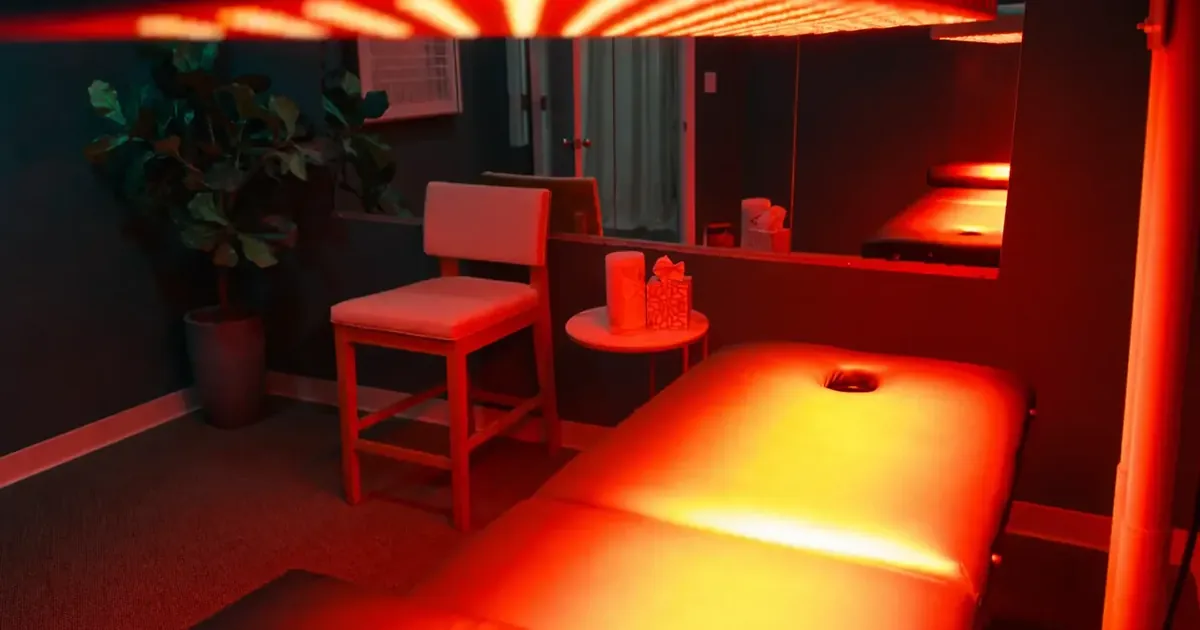
"How many sessions will this take?" is the most common question we hear about red light therapy. The honest answer depends on what you're treating, how long you've had it, and what's causing it. But there are clear patterns in the research that can help you set expectations.
How many red light therapy sessions does it take to see results?
For musculoskeletal pain, think in terms of a course, not a single session. Many trials in the pain research deliver treatment two to three times per week for several weeks, and that's a reasonable starting expectation for chronic problems.
Here's a realistic timeline:
| Phase | What's typical |
|---|---|
| First 1–3 sessions | Some people feel less pain or stiffness right away; others notice little. Both are normal. |
| Weeks 2–4 | Changes become more consistent — easier movement, fewer flare-ups, less guarding. |
| End of the course | The bulk of the treatment effect is usually in place. |
| Weeks after finishing | Benefits often continue — and sometimes grow — after the last session. |
That last row surprises people, but the research backs it up. In a 2019 BMJ Open meta-analysis on knee osteoarthritis (22 trials, 1,063 participants), pain reduction from recommended doses peaked 2–4 weeks after therapy ended, at roughly 32 points on a 100-point scale beyond placebo. In a Lancet meta-analysis on neck pain, chronic neck pain relief lasted up to 22 weeks after treatment was completed.
How often should you do red light therapy?
For a treatment course, sessions are usually spaced a day or more apart so the tissue has time to respond. Daily, high-intensity sessions aren't automatically better.
That's because red light follows a biphasic dose response: too little light does nothing, the right amount helps, and too much can cancel out the benefit. More frequent and longer isn't the same as more effective.
After a course, some people move to occasional maintenance sessions, especially athletes in heavy training or people with recurring flare-ups.
How long is each red light therapy session?
Clinical treatment time per area commonly ranges from a few minutes to about 20 minutes, depending on the device's power, the wavelength, how deep the target tissue is, and the size of the area being treated. A powerful clinical device may need less time than a weaker one to deliver the same dose.
What factors change how many sessions you need?
- How long you've had pain. A two-week flare usually responds faster than a five-year problem.
- What's causing it. Inflammation-driven pain may respond quickly to light. Pain driven by mechanical restriction — tight fascia, adhesions — needs hands-on work too.
- Where it is. Deep joints and large muscle groups may need different dosing than superficial areas.
- Your activity level. Continuing to aggravate an area during treatment slows progress.
- Whether light is paired with other care. Red light combined with soft tissue therapy addresses both irritation and the restriction behind it.
What does a red light therapy session feel like?
Most people find it easy and relaxing:
- You'll wear eye protection. Bright red and near-infrared light can strain the eyes.
- The light is positioned over the treatment area. Skin is usually exposed for best results.
- You'll feel little to nothing — maybe mild warmth. It shouldn't hurt.
- There's no downtime. You can return to normal activity right after.
At Body In Gear, light is typically one part of a visit that also includes hands-on soft tissue work on the same problem area.
What should you do between sessions?
- Stay active within comfort. Gentle movement supports recovery; total rest usually doesn't help chronic pain.
- Follow your home program. Self-care and corrective exercises between visits make sessions go further.
- Track what changes. Note pain levels, stiffness, sleep, and what activities feel easier. That helps your provider adjust the plan.
- Be consistent. Skipping sessions in the middle of a course makes results harder to judge.
How do you know red light therapy is working?
Signs of progress include:
- Lower average pain, or fewer bad days per week
- Moving more freely — reaching, bending, walking, sleeping
- Flare-ups that are milder or shorter
- Being able to tolerate activity or deeper hands-on work that used to be too uncomfortable
If you've completed a reasonable trial and nothing has changed, that's useful information. It may mean light isn't the right tool for your specific problem, or that something else — like a mechanical restriction or a non-soft-tissue cause — needs to be addressed first. A good provider will tell you that instead of selling more sessions.
Can you do too much red light therapy?
Yes, in the sense that excess dose can reduce benefit. Using a device far longer or more often than intended doesn't speed things up. Overexposure without eye protection can also irritate the eyes.
Related: What red light therapy is · Red light therapy for joint and back pain · Red light therapy for muscle recovery · Red Light Therapy hub
Frequently asked questions
Can one red light therapy session help? Some people feel short-term relief after one session, but research on pain typically uses a series. Expect a course, not a one-time fix.
Is it OK to do red light therapy every day? For a treatment course, sessions are often spaced a day or more apart. More frequent isn't necessarily better because of the biphasic dose response.
How long do red light therapy results last? In chronic neck pain research, relief lasted up to 22 weeks after treatment ended. Maintenance needs vary by person and condition.
When will I know if red light therapy isn't working for me? If there's no meaningful change after a reasonable course, it's time to reassess the cause of your pain and the treatment plan.
Do I need to undress for red light therapy? Light works best on exposed skin over the treatment area. You'll only need to expose the area being treated.
Want a straight answer on how many sessions you'd need? Book an evaluation at Body In Gear in Palatine. We'll assess the cause of your pain and give you a realistic plan, not an open-ended package.
Medical disclaimer: This article is for educational purposes only and is not medical advice. Talk with your physician before starting red light therapy if you are pregnant, have a cancer history, have a thyroid condition, or take photosensitizing medications.
About the author
Zach Mayfield, LMT is the owner of Body In Gear in Palatine, IL, a clinic focused on root-cause, non-pharmaceutical pain resolution through myofascial release, manual adhesion technique, and medical massage.
Clinically reviewed by Darshan Patel, PT, DPT, a Doctor of Physical Therapy at Body In Gear.
References
- Stausholm MB, et al. Efficacy of low-level laser therapy on pain and disability in knee osteoarthritis: systematic review and meta-analysis of randomised placebo-controlled trials. BMJ Open. 2019;9(10):e031142. https://pmc.ncbi.nlm.nih.gov/articles/PMC6830679/
- Chow RT, et al. Efficacy of low-level laser therapy in the management of neck pain: a systematic review and meta-analysis. Lancet. 2009;374(9705):1897–1908. https://pubmed.ncbi.nlm.nih.gov/19913903/
- Huang YY, Chen AC, Carroll JD, Hamblin MR. Biphasic dose response in low level light therapy. Dose Response. 2009;7(4):358–383. https://pmc.ncbi.nlm.nih.gov/articles/PMC2790317/