Red light therapy and soft tissue therapy solve different halves of chronic pain. Red light reduces inflammation and gives irritated cells more energy to repair. Hands-on soft tissue work — medical massage, myofascial release, and adhesion release — fixes the mechanical restriction that keeps causing pain. Together, they address both the irritation and its source.
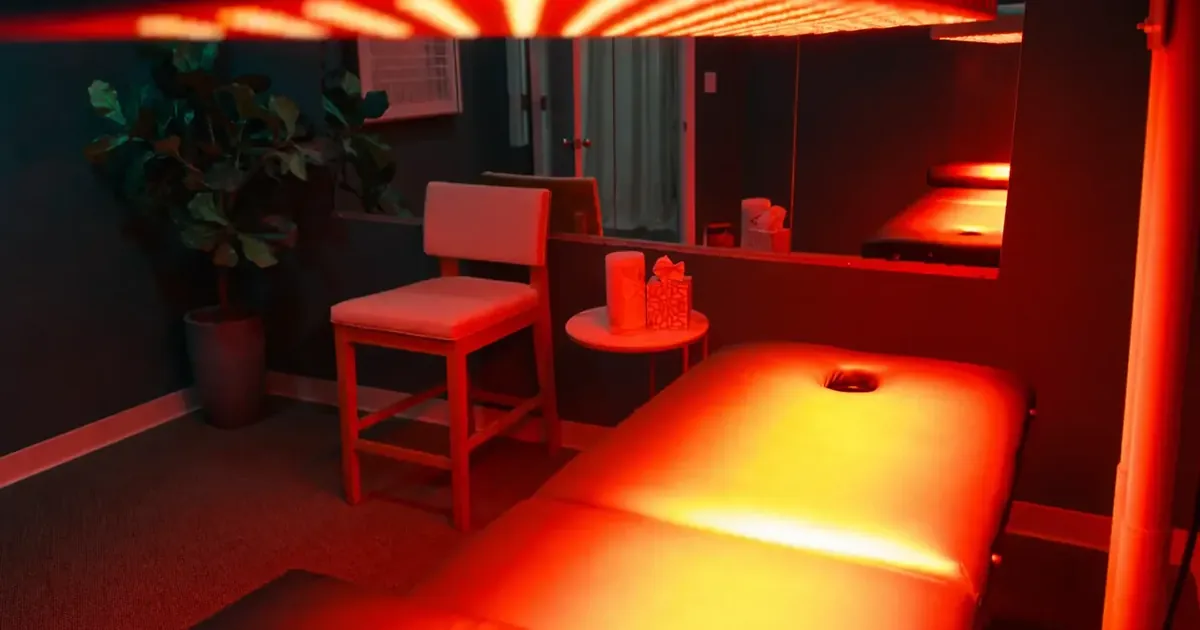
Most chronic pain isn't one problem. It's usually a cycle: a muscle or layer of fascia gets restricted, it pulls on joints or squeezes a nerve, the area gets irritated and inflamed, your body guards it, and the restriction gets worse. Breaking that cycle usually takes more than one tool.
Why combine red light therapy with soft tissue therapy?
Because each one is weak exactly where the other is strong.
| Red light therapy | Soft tissue therapy | |
|---|---|---|
| What it targets | Cellular energy, inflammation, pain signaling | Mechanical restriction: tight fascia, adhesions, guarded muscle |
| How it works | Light absorbed by mitochondria shifts cell chemistry | Pressure, stretch, and nervous system regulation change tissue and tone |
| Strength | Calms irritated tissue without force | Releases the restriction that's causing the pain |
| Limitation | Can't "unstick" fascia or separate adhered muscles | Very irritated tissue can be too reactive to treat deeply |
Red light can turn down the volume on irritated tissue. But if a stuck layer of fascia keeps tugging on a joint, the irritation comes right back. Soft tissue therapy can release that restriction — but tissue that's highly inflamed and guarded is harder to work deeply. Pairing them covers both gaps.
What does red light therapy add to hands-on treatment?
The research on red light (photobiomodulation) points to three benefits that matter during soft tissue work:
- Lower inflammation. Hamblin's 2017 review describes reduced inflammatory markers and a shift of immune cells toward repair after light exposure.
- Pain relief that lasts. In a Lancet meta-analysis of 16 trials, chronic neck pain patients reported meaningful relief up to 22 weeks after treatment — and the authors noted benefits appeared whether light was used alone or alongside exercise and stretching.
- Better-supported muscle recovery. A 2016 review by Ferraresi, Huang, and Hamblin summarized evidence that light can improve muscle performance and reduce exercise-induced muscle damage.
That makes red light a natural complement to manual therapy, which deliberately loads and changes tissue.
What does soft tissue therapy add that red light can't?
Soft tissue therapy is the umbrella for hands-on work on muscles, fascia, tendons, and ligaments. At Body In Gear, that includes:
- Medical massage — treatment-focused, outcome-driven massage that calms the nervous system and prepares tissue for deeper work
- Myofascial release — slow, sustained pressure and stretch that restores glide to restricted fascia
- Manual adhesion technique (MAT) — locating and releasing spots where two muscles with overlapping actions have "glued" together, such as where the trapezius and rhomboids meet between the shoulder blades
- Cupping and assisted stretching when they fit the case
Hands-on care has its own evidence base. In a randomized trial of 401 adults with chronic low back pain, published in the Annals of Internal Medicine, massage produced better function and symptom improvement than usual care at 10 weeks.
What none of that research can tell you is where the restriction is. That takes hands. We find adhesions and fascial restrictions by palpation — physically feeling for them — before treating them.
Should red light therapy come before or after massage?
There isn't a single rule in the research, and good clinicians adjust by case. Here's how we think about it:
- Before hands-on work makes sense when tissue is highly irritated or guarded. Calming it first can let us work deeper with less discomfort.
- After hands-on work makes sense when we want to support the tissue we just loaded — similar to how athletes use light for recovery after training.
- Some cases use both, especially in early sessions for long-standing pain.
What matters more than order is that both pieces target the same problem area identified during your evaluation.
Why most clinics can't offer this combination well
Pairing light with soft tissue therapy only works if there's enough soft tissue therapy to pair it with.
In many PT and chiropractic offices, soft tissue work is a brief add-on: a few minutes with a massage gun or quick trigger point pressure before exercises. Putting a red light panel next to five minutes of manual work doesn't change much.
Body In Gear provides 1,400% more soft tissue therapy than the average PT or chiropractic clinic. We dedicate full 50-minute sessions to soft tissue work, following a deliberate sequence: medical massage to open up the nervous system, then myofascial release, then MAT for adhesions. In our clinical experience, the large majority of chronic pain patients — roughly 8 in 10 — have pain rooted in soft tissue dysfunction, which is why we built the clinic around this depth.
Red light fits into that framework as a supporting tool. It doesn't replace the hands-on work; it makes the hands-on work more comfortable and its results more durable.
Who benefits most from the combination?
The pairing tends to help most when pain has both an inflammatory and a mechanical component:
- Chronic low back or neck pain with tight, tender, guarded muscle
- Shoulder and upper back pain from adhesions between the shoulder blades
- Overuse pain near joints, like tendon irritation at the elbow or knee
- Athletes and active people recovering from hard training blocks
- People who found standard PT or massage helped briefly but didn't last
What does a combined session look like?
A typical combined visit starts with a check-in on how you responded last time. Your therapist targets the problem areas found in your evaluation with hands-on work and applies red light to the same region, before or after manual therapy depending on how irritated the tissue is. You leave with guidance on self-care between sessions.
Related: What red light therapy is · Red light therapy for joint and back pain · Myofascial release vs. massage · Red Light Therapy hub · Soft tissue therapy
Frequently asked questions
Can I get red light therapy and massage on the same day? Yes. Combining them in the same visit is common and lets both treatments target the same tissue.
Is red light therapy alone enough for chronic pain? Sometimes it reduces pain, but if a mechanical restriction is driving the problem, light alone usually won't resolve it. That's why we pair it with soft tissue work.
Does red light therapy make massage hurt less? It may. Calming irritated, guarded tissue can make deeper manual work more comfortable for some people.
What is manual adhesion technique? MAT is a hands-on method for finding and releasing adhesions — places where neighboring muscles with overlapping actions have stuck together — to restore movement and relieve nerve compression.
How many combined sessions will I need? It depends on how long you've had pain and what's causing it. See how many red light therapy sessions you need for typical timelines.
Want both halves of the problem treated? Book an evaluation at Body In Gear in Palatine and we'll build a plan that pairs the right tools for your pain.
Medical disclaimer: This article is for educational purposes only and is not a substitute for professional medical advice. Consult your physician before starting new treatments, especially if you have a cancer history, are pregnant, or take photosensitizing medications.
About the author
Zach Mayfield, LMT is the owner of Body In Gear in Palatine, IL, a clinic focused on root-cause, non-pharmaceutical pain resolution through myofascial release, manual adhesion technique, and medical massage.
Clinically reviewed by Darshan Patel, PT, DPT, a Doctor of Physical Therapy at Body In Gear.
References
- Hamblin MR. Mechanisms and applications of the anti-inflammatory effects of photobiomodulation. AIMS Biophys. 2017;4(3):337–361. https://pmc.ncbi.nlm.nih.gov/articles/PMC5523874/
- Chow RT, et al. Efficacy of low-level laser therapy in the management of neck pain: a systematic review and meta-analysis. Lancet. 2009;374(9705):1897–1908. https://pubmed.ncbi.nlm.nih.gov/19913903/
- Ferraresi C, Huang YY, Hamblin MR. Photobiomodulation in human muscle tissue: an advantage in sports performance? J Biophotonics. 2016;9(11-12):1273–1299. https://pmc.ncbi.nlm.nih.gov/articles/PMC5167494/
- Cherkin DC, et al. A comparison of the effects of 2 types of massage and usual care on chronic low back pain: a randomized, controlled trial. Ann Intern Med. 2011;155(1):1–9. https://pubmed.ncbi.nlm.nih.gov/21727288/